
Foolproof Revani (Turkish Semolina Cake in Syrup) with Perfect Measurements
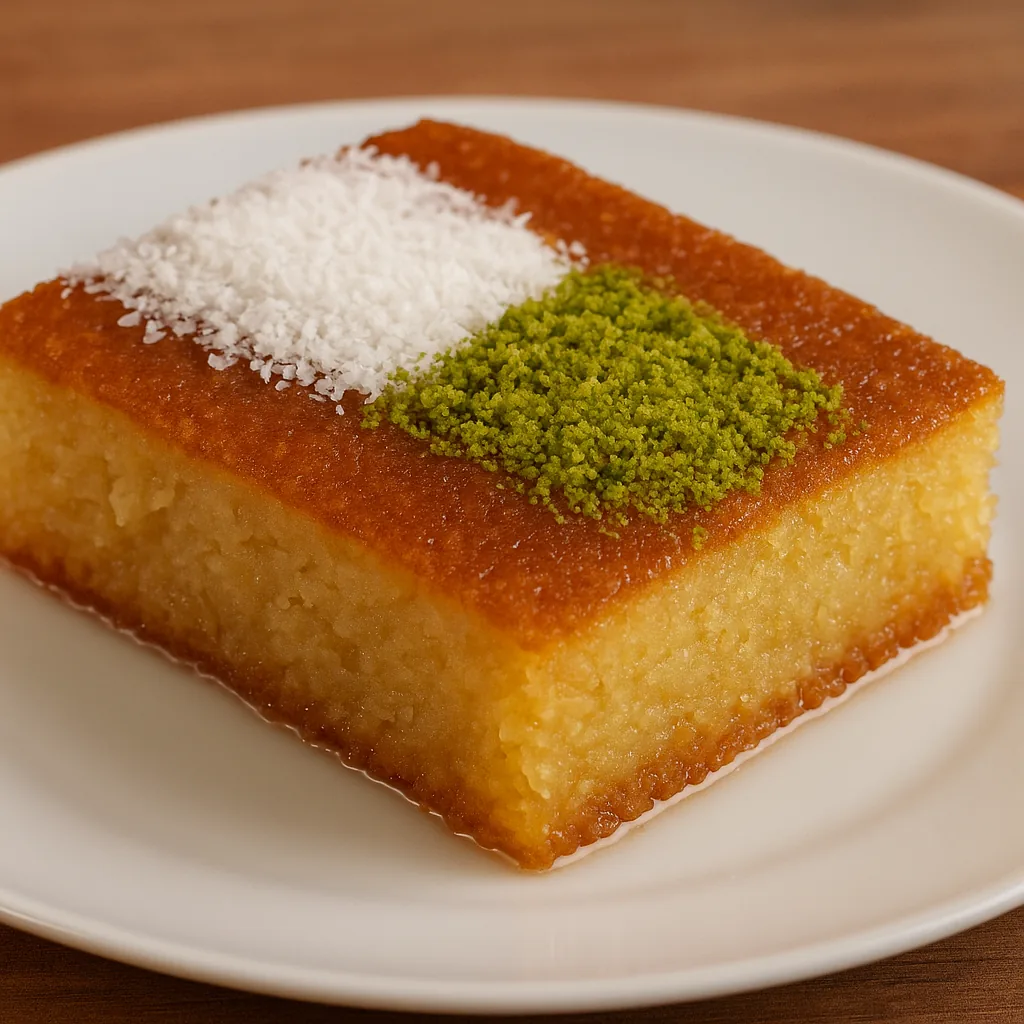
Revani is a semolina dessert that has been surrounded by all kinds of stories since Ottoman times. It is often described as stretching from palace kitchens to ordinary homes across Anatolia, and it’s one of the lightest, most elegant examples of Turkey’s syrup-dessert tradition. Thanks to the semolina, the texture isn’t as dense as baklava, but once it meets the syrup it turns soft and almost melts in your mouth. Those shiny golden slices in the middle of the tray at holiday tables, on guest days, and at get-togethers are a special moment in many homes, when everyone waits excitedly to see whether the measurements came out just right.
Over time, revani has become a recipe that every home changes with its own little touch. Some add orange zest for a richer aroma, some use orange juice in the syrup instead of lemon, and some leave the top plain while others decorate it generously with coconut or pistachios. What never changes is that revani tends to show up at big tables, family gatherings, and those “this dessert always works” moments. Even watching the batter rise, coming out of the oven, and slowly soaking up the syrup feels like a small kitchen ritual of its own.
Revani: A Little Treat;
Revani is a dessert, of course, made from simple ingredients like eggs, yogurt, and semolina. Because it’s soaked in syrup, I like to keep portions modest. One or two slices next to a glass of tea feels like a lovely little indulgence, the kind that nourishes the soul and gives you that “I had something homemade, made with love” feeling.
This information is for general purposes only and is not medical advice.
Foolproof Revani (Turkish Semolina Cake in Syrup)
Ingredients
Yapılışı
- Put the sugar and water in a small pot.
- Bring to a boil, stirring.
- Once it starts boiling, turn the heat down a little and let it simmer gently for about 8–10 minutes.
- Just before taking it off the heat, add the lemon juice and boil for 1–2 more minutes.
- Turn off the heat and let it cool at room temperature.
- This is very important: the syrup must be cold and the revani hot or warm.
- Start preheating the oven to 180°C (350°F), top and bottom heat.
- In a deep bowl, beat the eggs and sugar with a mixer for 3–4 minutes until pale and foamy.
- Add the yogurt and oil and mix for a short while longer.
- In a separate bowl, mix the flour, semolina, baking powder, and vanillin.
- Sift the dry ingredients into the wet mixture and mix with a spatula or the mixer on low speed until smooth.
- If you’re using lemon or orange zest, add it at this stage and stir.
- The batter shouldn’t be as thick as a heavy cake batter, nor as runny as crepe batter. It should be a bit thicker than classic cake batter and pourable from a spoon.
- Use a medium rectangular glass baking dish (Pyrex-style) or a greased baking pan of the same size.
- Grease the dish very lightly with butter or oil, and if you like, dust the bottom with a little flour.
- Pour in the batter and smooth the top with a spatula.
- Bake in the preheated 180°C (350°F) oven for about 30–35 minutes, until the top is golden and the inside is fully cooked.
- Don’t forget the toothpick test: if it comes out clean, the cake is done.
- Let the hot revani sit for 2–3 minutes after it comes out of the oven so the first steam can escape.
- If you want to cut it into pieces, do it now; the syrup will sink between the slices more nicely.
- Using a ladle, pour the cold syrup evenly over the hot or warm revani, covering every spot.
- Leave the pan to rest at room temperature.
- Let it rest for at least 1 hour so it can soak up the syrup and reach the perfect texture; if you have time, it’s even better to wait longer.
- Once the revani has soaked up its syrup and the top looks lightly glossy, sprinkle on coconut, pistachios, or finely chopped hazelnuts.
- Cut into squares for tea time, the kind that makes guests say “oh, maybe just one more piece?”
- If you like, serve it with a scoop of plain vanilla ice cream to take it to “restaurant dessert” level. 🙈🍨
Püf Noktaları
⭐ Have you tried this recipe? Rate it with stars below and tell me how it turned out; your comment helps other readers, too.
You May Also Like
- Şekerpare (Turkish Syrup Cookies) That Make Everyone Ask “Is This From a Bakery?”
- Carrot Revani with Walnuts & Hazelnuts (Havuçlu Revani, Turkish Semolina Syrup Cake)
- Trilece Recipe (Turkish Three-Milk Caramel Cake)
Frequently Asked Questions About Revani
How long does revani keep, and should I store it in the fridge?
Revani keeps for about 1 day at cool room temperature if the kitchen isn’t warm. For longer storage, cover it and refrigerate for up to 3 to 4 days. Take a slice out 15 to 20 minutes before serving so the texture softens again.
Can I freeze this revani recipe?
Yes, revani freezes fairly well. Let it soak and cool completely, cut it into portions, and wrap them tightly or put them in an airtight container for up to 1 month. Add the coconut or pistachios after thawing, and thaw the pieces in the fridge overnight.
Why did my revani turn out soggy or pasty instead of light and syrupy?
The most common cause is syrup and cake temperature. If both are hot, the cake turns pasty. Syrup that was too thin because it was simmered too briefly, or poured on in too large an amount, can also make it soggy. Stick to the 8 to 10 minute simmer and pour the cold syrup evenly with a ladle.
Can I use coarse semolina for revani instead of fine semolina?
You can, but the cake will be grainier and take up the syrup more slowly. If you only have coarse semolina, let the finished batter rest for 10 to 15 minutes before baking so the grains soften a little. Fine semolina still gives the smoothest, most tender slices.
What size pan should I use for this revani recipe, and can I double it?
A medium rectangular baking dish, roughly 22×32 cm (9×13 in), works well and gives 12 servings. If you double the recipe, use a large tray or two dishes so the batter stays thin enough to bake through. A very deep dish may need extra baking time, so check with a toothpick.
Similar recipes
 9 hr 45 min
Honey Cocoa Spartak Pasta (Turkish Layered Cake, Homemade)
 1 hr 30 min
Volkan Kek (Turkish Chocolate Volcano Cake with Molten Chocolate Sauce)
 1 hr 50 min
Mini Köstebek Pasta (Individual Turkish Mole Cakes with Banana & Cream)
 43 min